
In Malaysia’s rapidly evolving business landscape, ERP implementation is a transformative strategy for organizations seeking to optimize operations and stay competitive. Enterprise Resource Planning (ERP) systems integrate critical functions - finance, supply chain, human resources, and more - into a unified platform, addressing challenges like regulatory compliance with the Inland Revenue Board (IRB) and supporting Malaysia’s diverse, multicultural workforce. This guide, tailored for the Malaysian market, provides a detailed roadmap for successful ERP deployment.
What is ERP Implementation?
ERP implementation is the process of selecting, configuring, and deploying an ERP system to align with an organization’s unique needs. It involves planning, where business requirements are defined; configuration or customization to match workflows; integration with existing tools; data migration from legacy systems; rigorous testing; rollout to users; and ongoing support. In Malaysia, ERP systems, such as Odoo, must comply with local regulations, such as GST/SST reporting and integration with MyInvois for e-invoicing, while addressing cultural nuances in a multilingual workforce.
Why is ERP implementation critical?
It drives efficiency by automating repetitive tasks, reducing errors in industries like manufacturing, where Malaysia faces labor shortages. Real-time data visibility empowers businesses to respond to market shifts, such as fluctuations in the palm oil sector, with studies showing 20-30% cost reductions post-implementation. ERP ensures compliance with laws like the Personal Data Protection Act (PDPA) and anti-corruption regulations, standardizing processes across departments. For Malaysian SMEs eyeing ASEAN trade, ERP supports scalability without proportional cost increases
Why ERP Implementation is Critical for Business Success
- Enhanced Efficiency: By automating routine tasks and standardizing processes, ERP reduces manual errors and speeds up operations, crucial for Malaysian industries like manufacturing and logistics facing labor shortages.
- Improved Data Visibility: Real-time analytics provide insights into inventory, sales, and finances, helping businesses respond to market fluctuations, such as those in the palm oil sector.
- Standardization and Compliance: ERP ensures consistent processes across departments, aiding adherence to Malaysian regulations like the Personal Data Protection Act (PDPA) and anti-corruption laws.
- Scalability for Growth: As Malaysian SMEs expand regionally via ASEAN trade, ERP supports scaling without proportional cost increases, fostering innovation and competitiveness.
- Cost Savings: Over time, ERP minimizes redundancies, optimizes resource allocation, and boosts productivity, with studies showing up to 20-30% reduction in operational costs post-implementation.
Different Types of ERP Systems: Cloud, On-Premises, Hybrid
Selecting the right ERP system is a critical decision for businesses, especially with the push from the Malaysia Digital Economy Blueprint. Each deployment model offers distinct advantages:
- Cloud ERP: This model provides affordability, scalability, and remote access, making it perfect for SMEs and mobile workforces. With Malaysia’s 5G rollout enhancing connectivity, cloud solutions like Odoo are increasingly popular, though they require reliable internet.
- On-Premises ERP: This option delivers full control and customization, ideal for high-security sectors like oil and gas, but it demands significant investment in hardware and ongoing maintenance.
- Hybrid ERP: Combining cloud flexibility with on-premises security, this model suits businesses transitioning from legacy systems, though it can be complex and costly to manage.
Type | Pros | Cons |
Cloud ERP | Cost-effective, scalable, remote access, ideal for Malaysia’s 5G rollout | Internet dependency, potential security concerns for regulated industries |
On-Premises ERP | High control, customizable, secure for sensitive data | High initial costs, ongoing maintenance burden |
Hybrid ERP | Balances security and flexibility, supports phased migration | Complex management, higher costs than cloud |
The ERP Implementation Lifecycle: Key Phases Explained
The ERP implementation lifecycle, typically spanning 6-18 months, provides a clear roadmap to ensure a successful deployment. For Malaysian businesses, aligning the system with local requirements - such as EPF/SOCSO integration and Bahasa Malaysia interfaces - is essential for maximizing value. Each phase builds on the previous one, creating a cohesive process.
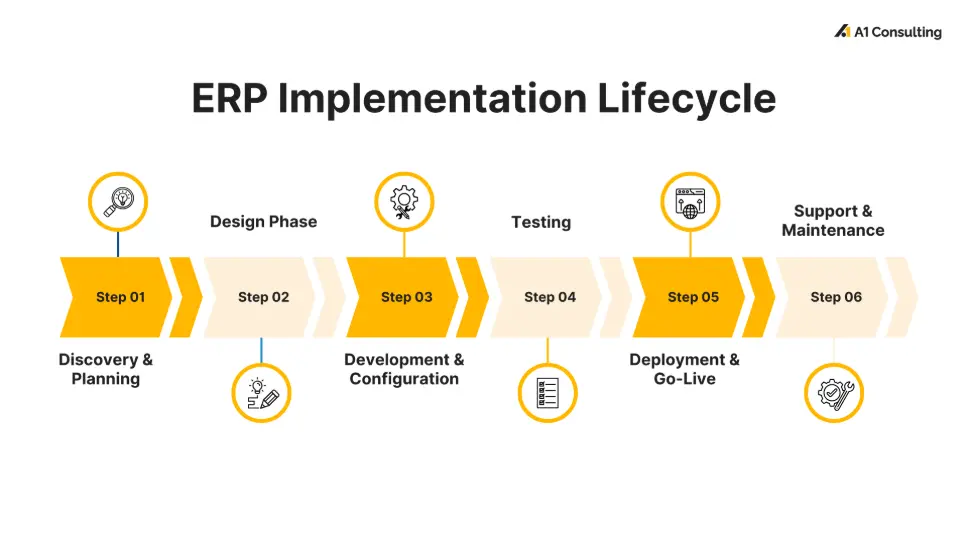
Discovery & Planning
Identifying Stakeholders and Setting the Project Team
Begin by mapping stakeholders, including executives, department heads, and end-users. Form a cross-functional team with roles like project manager, IT specialist, and business analyst. In Malaysia, include representatives from diverse ethnic groups to ensure cultural sensitivity in change management.
Business Needs Analysis and System Requirements
Conduct workshops to assess current processes, identify pain points (e.g., inefficient supply chains in Malaysia's export-driven economy), and define requirements. Use tools like SWOT analysis to prioritize features.
ERP Vendor Selection: Criteria and Considerations (Cloud vs On-Premises)
Evaluate vendors based on scalability, cost, support, and Malaysia-specific compliance. Compare cloud for quick deployment versus on-premises for data sovereignty. Shortlist options through RFPs and demos.
Budgeting and Timeline Establishment
Estimate costs (e.g., software licenses, training) and create a Gantt chart for timelines. Allocate buffers for challenges like Malaysia's bureaucratic approvals. Deliverables: Project charter, budget plan, and vendor shortlist.
Design Phase
Current Process Mapping
Document "as-is" workflows using flowcharts, highlighting inefficiencies like manual invoicing prone to errors under SST rules.
Gap Analysis and Workflow Design
Compare current processes against ERP capabilities to identify gaps. Design "to-be" workflows, incorporating best practices like automated reporting. Use block quotes for examples: "In a Malaysian manufacturing firm, gap analysis revealed the need for custom modules to handle halal certification tracking, leading to streamlined compliance."
Development and Configuration
Customization vs Configuration
Prefer configuration (adjusting settings) over heavy customization to ease future updates. In Malaysia, configure for multi-currency support in trade-heavy sectors.
- Customization: For unique needs, like integrating with local payment gateways.
- Configuration: Standard adjustments, reducing long-term maintenance.
Data Migration Strategy and Execution
Plan extraction, transformation, and loading (ETL) of data. Cleanse duplicates and validate for accuracy, especially financial data for IRB audits.
Integration with Existing Systems
Link ERP to CRM or e-commerce platforms. Ensure seamless data flow to avoid silos.
Testing
Unit and Integration Testing
Test individual modules and interconnections step-by-step.
User Acceptance Testing (UAT)
Involve users in real scenarios, gathering feedback for adjustments.
Issue Tracking and Problem Resolution
Use tools like Jira to log and resolve bugs, ensuring quality assurance.
Deployment and Go-Live
Go-Live Planning and Execution
Develop a cutover plan with rollback options. In Malaysia, schedule around holidays like Hari Raya for minimal disruption.
Data Validation and Legacy System Transition
Verify migrated data and phase out old systems gradually.
Timeline Milestone | Action |
Week 1 | Final data migration |
Week 2 | System activation |
Week 3 | Monitoring and tweaks |
Post-Implementation Support and Maintenance
Continuous User Training and Support
Offer role-based training and helpdesks to address queries.
System Updates, Monitoring, and Improvements
Schedule updates, monitor KPIs, and collect feedback for optimizations. In Malaysia, align with digital trends like Industry 4.0.
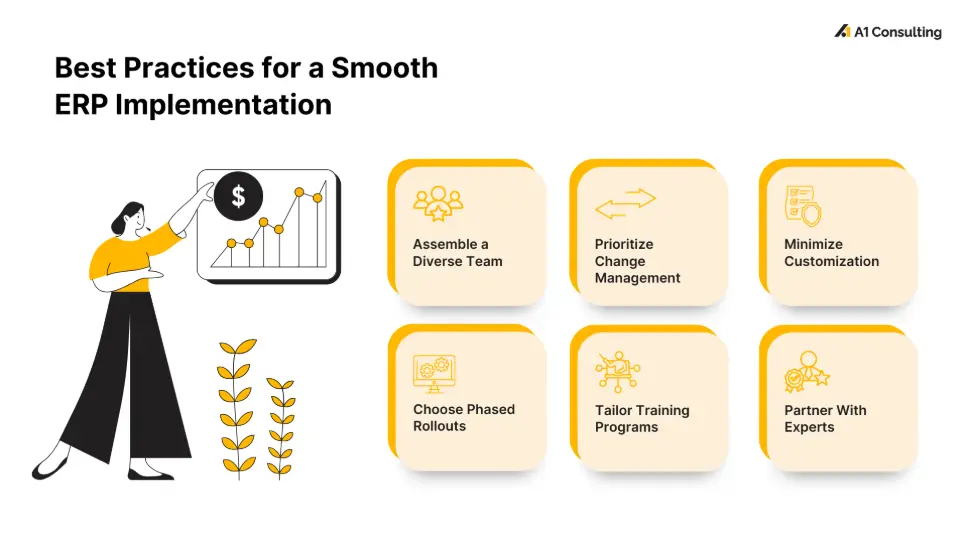
Best Practices for a Smooth ERP Implementation
To achieve a seamless ERP implementation, Malaysian businesses should follow these proven strategies, each designed to address local challenges and maximize ROI:
- Assemble a Diverse Team: Businesses should build a cross-functional team with representatives from finance, operations, and IT to ensure comprehensive stakeholder buy-in, particularly in Malaysia’s hierarchical organizations.
- Prioritize Change Management: To overcome resistance, common in traditional Malaysian workplaces, companies should host workshops and demonstrate benefits like faster workflows and improved work-life balance.
- Minimize Customization: By leveraging Odoo’s out-of-the-box modules, businesses can reduce maintenance costs and simplify upgrades, ensuring long-term efficiency.
- Choose Phased Rollouts: Phased deployments minimize risks in complex sectors like logistics, allowing businesses to address issues incrementally.
- Tailor Training Programs: Companies should customize training for user roles, incorporating local languages like Bahasa Malaysia to boost adoption and user confidence.
- Partner with Experts: Collaborating with experienced ERP consultants, for example, A1 Consulting - Certified Odoo Gold Partner, can provide valuable localized expertise, helping businesses navigate Malaysian regulations and cultural nuances for optimal results.
These practices, rooted in industry experience, create a cohesive strategy that drives successful ERP adoption.
Emerging Trends Shaping ERP Implementation
As we approach 2025, ERP implementation is evolving with technology advancements.
- Cloud ERP and SaaS Adoption: Increasing in Malaysia for cost-effectiveness and remote access, driven by 5G rollout.
- AI and Machine Learning Integration: Automating predictive analytics for inventory in retail sectors.
- Mobile ERP and Remote Access Capabilities: Essential for Malaysia's hybrid work models post-pandemic.
- Sustainability Initiatives in ERP Systems: Tracking carbon footprints to meet ESG standards.
- Subscription-Based ERP Models and Pricing Trends: Flexible pricing aids SMEs, with pay-as-you-go options gaining popularity.
How to Evaluate ERP Vendors Effectively?
Choosing the right ERP vendor is crucial for success. Businesses should evaluate vendors based on scalability, user-friendliness, integration capabilities, and support tailored to Malaysian regulations. Key questions to ask include: “How does your ERP handle SST compliance?” and “What is your post-implementation support turnaround time?”.
Capability | On-Premises | Cloud | Hybrid |
Cost | High upfront | Subscription | Mixed |
Support | In-house | Vendor-managed | Combined |
Post-Implementation: How to Measure ERP Success?
Metrics and KPIs for ERP Project Evaluation
Track ROI via reduced cycle times, error rates, and cost savings. In Malaysia, measure compliance efficiency.
User Feedback and Continuous Improvement Loops
Use surveys and analytics to refine, ensuring ongoing value.
- KPI List: Inventory turnover, order fulfillment rate, financial close time.
Transform Your Business with ERP today
ERP implementation is a transformative step for Malaysian businesses, delivering efficiency, compliance, and scalability in a competitive market. By streamlining operations, ensuring regulatory adherence, and enabling data-driven decisions, ERP can reduce costs by 20-30% and drive significant ROI. Poor planning risks delays, low adoption, or integration failures, but a cohesive strategy - built on diverse teams, phased rollouts, and expert guidance - ensures success. A1 Consulting’s Odoo ERP services are tailored to Malaysia’s unique needs, from SST compliance to multicultural support. Ready to elevate your business? Contact A1 Consulting today to harness Odoo’s power and unlock your potential for growth.
Frequently Asked Questions on ERP Implementation
1. What is the difference between customization and configuration in ERP?
Customization involves coding changes to the core system, which can complicate updates, while configuration adjusts existing settings without altering code - preferred for maintainability.
2. Is cloud ERP always better than on-premises ERP?
Not always; cloud offers scalability but on-premises provides more control for sensitive data in regulated Malaysian industries like banking.
3. Can a small business successfully implement an ERP system?
Yes, with scalable cloud solutions and phased approaches, Malaysian SMEs can achieve ROI through government grants like those from MDEC.
4. What are common mistakes to avoid during ERP implementation?
- Underestimating change management.
- Poor data preparation.
- Over-customization.
- Ignoring user training.

Sally N.
BDM - Partner and Alliance
With over 7 years of experience in ERP advisory, Sally has worked closely with SMEs across Malaysia to streamline operations and drive digital transformation. Her deep understanding of business processes and hands-on approach have made her a trusted advisor to many growing companies. Through this blog post, Sally aims to share practical insights and real-world lessons drawn from her implementation experience, offering guidance to businesses navigating their own ERP journey.