
Introduction
Across Malaysia, businesses are facing a familiar challenge: operations are growing, but inventory systems are not keeping up.
From manufacturing plants in Johor to retail chains in Kuala Lumpur, many companies still rely on fragmented tools or legacy inventory software that were never designed for today’s pace of business. The result is often the same including stock discrepancies, delayed reporting, and limited visibility across warehouses.
As digital transformation accelerates, more Malaysian businesses are re-evaluating their approach to inventory management. This is where the Odoo inventory management enters the conversation, not just as a tool, but as part of a fully integrated ERP ecosystem.
Understanding Inventory Systems in Malaysia
Inventory management in Malaysia sits at the intersection of rapid digital growth, fragmented legacy systems, and increasing regulatory pressure. Unlike more mature markets, many Malaysian businesses are still in a transitional phase that moving from operational convenience toward structured, data-driven management.
Malaysia’s economy is heavily driven by SMEs, which account for over 97% of total businesses and contribute significantly to GDP and employment. Inventory management in Malaysia is uniquely complex as businesses often operate across multiple channels from physical stores, e-commerce platforms, and distribution networks while also navigating local compliance requirements such as SST and the upcoming e-invoicing framework under LHDN (MyInvois).
Traditional inventory software has historically served SMEs well. Solutions like standalone accounting or inventory tools are widely used due to their affordability and simplicity. However, as operations scale, these systems begin to show limitations.
Modern systems such as Odoo inventory systems, on the other hand, are designed for integration, scalability, and real-time control, which could help to align more closely with how businesses operate today.
What Is the Odoo Inventory Management?
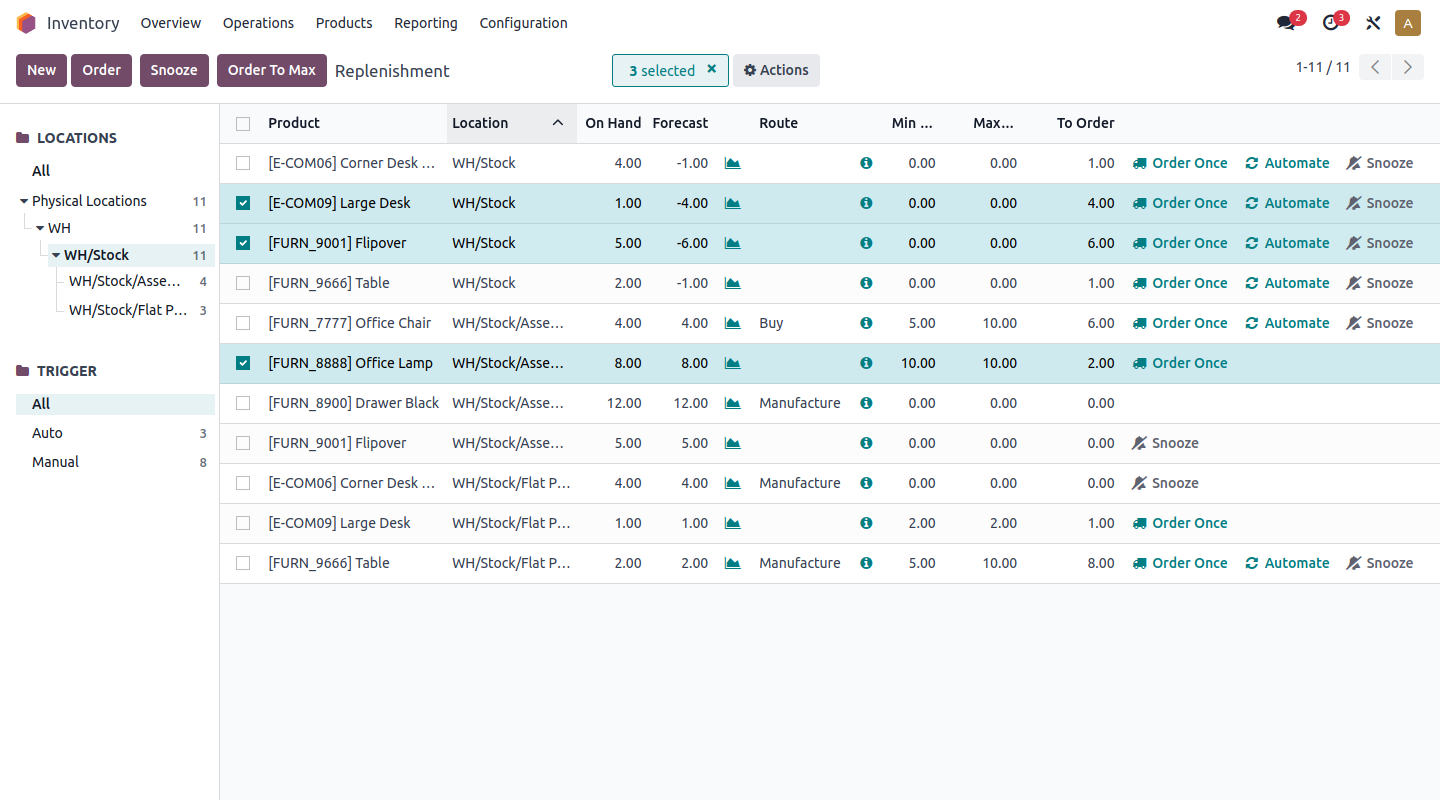
Odoo inventory management is part of the broader Odoo ERP platform, offering end-to-end inventory management tightly integrated with sales, purchasing, accounting, manufacturing and e-commerce. Rather than functioning as a standalone tool, it serves as a central hub that connects all inventory-related activities in real-time.
Key capabilities include:
- Real-time inventory tracking across multiple warehouses
- Automated replenishment and reordering rules
- Barcode scanning and mobile operations
- Batch and serial number tracking
- Integration with accounting and e-invoicing workflows
- Seamless connection with e-commerce and POS systems
With its core strengths is real-time inventory visibility, businesses can track stock levels instantly across multiple warehouses, retail outlets, or locations, with automated updates triggered by sales orders, receipts, or internal transfers. This eliminates the need for manual reconciliation and reduces the risk of stock discrepancies. The system also supports advanced warehouse operations, including barcode scanning, batch and serial number tracking, and smart routing methods such as dropshipping or cross-docking. All designed to improve speed and accuracy in daily operations.
Moreover, Odoo inventory management offers strong automation and planning capabilities. Features such as automated reordering rules, demand forecasting, and procurement integration help businesses maintain optimal stock levels without overstocking or stockouts. Because it is tightly linked with accounting and invoicing, inventory movements can also trigger financial entries, ensuring alignment between operations and financial reporting. A critical advantage for compliance and decision-making in markets like Malaysia.
What Defines Traditional Inventory Software in Malaysia?
In Malaysia, traditional inventory software typically refers to standalone systems or basic modules embedded in accounting tools. These solutions were originally designed to help businesses record stock movements, generate simple reports, and support financial reconciliation. For many SMEs, they offered a practical starting point that is affordable, easy to use, and sufficient for small-scale operations.
However, in today’s context, these systems are increasingly showing their limitations.
One of the biggest challenges is the lack of integration. Inventory data often sits separately from sales, purchasing, and accounting, requiring manual updates or periodic synchronization. This leads to inconsistencies between departments, for example, sales teams may confirm orders without accurate stock visibility, while finance teams spend significant time reconciling mismatched data.
Another critical issue is the absence of real-time visibility. Traditional systems often rely on batch updates or manual input, meaning stock levels are not always accurate at any given moment. In the Malaysian market, where businesses operate across retail, e-commerce, and distribution channels simultaneously, this creates frequent problems such as overselling, stock shortages, and delayed fulfillment.
Operational inefficiency is also a major concern. Many companies still rely on spreadsheets or manual processes for stock counting, replenishment planning, and reporting. As transaction volumes grow, these processes become time-consuming, error-prone, and difficult to scale, especially in environments with labour constraints.
From a strategic perspective, traditional systems are not built to support business growth and regional expansion. Managing multiple warehouses, companies, or cross-border operations often requires workarounds or additional systems, resulting in fragmented data and limited control at the management level.
Finally, with Malaysia’s shift toward e-invoicing (MyInvois) and increasing compliance requirements, disconnected systems create higher risks. Inventory, sales, and financial data must now align more closely, and traditional setups struggle to provide the level of traceability and audit readiness required.
Why Businesses Are Moving Toward the Odoo Inventory Management
In contrast, Odoo inventory management addresses these challenges by providing a fully integrated and real-time approach to inventory management.
Instead of operating in silos, Odoo connects inventory with sales, purchasing, and accounting in a single platform. This ensures that every stock movement is automatically reflected across the business, eliminating manual reconciliation and improving data accuracy. Furthermore, real-time visibility allows businesses to make faster and more confident decisions. Whether managing multiple warehouses or multiple sales channels, companies gain a clear, up-to-date view of stock levels and movements at any moment.
Automation further enhances efficiency. Processes such as replenishment, order fulfillment, and reporting can be streamlined, reducing reliance on manual work and minimizing operational errors.
Most importantly, Odoo inventory management is designed for scalability. It supports multi-company structures, regional expansion across Southeast Asia, and integration with other business functions, making it suitable not just for current needs, but for future growth.
In an environment where businesses must balance efficiency, compliance, and scalability, the shift from traditional inventory software to an integrated system like Odoo is a strategic move.
Comparison: Odoo Inventory Management vs Traditional Software
System Architecture and Integration
Traditional systems operate in silos. Inventory data is often disconnected from sales, finance, and procurement, requiring manual reconciliation.
The Odoo inventory management is fully integrated within an ERP environment. When a sale is confirmed, inventory updates automatically. When stock moves, accounting entries can be triggered in real time. For Malaysian businesses dealing with multi-entity structures or group-level reporting, this integration becomes critical.
Real-Time Visibility vs Periodic Updates
One of the biggest operational gaps in traditional systems is the lack of real-time visibility.
Stock levels are often updated:
- At the end of the day
- After manual reconciliation
- Through batch processing
With Odoo, inventory data is updated instantly across all locations. This is particularly important for:
- Retail chains managing multiple outlets
- Distributors handling high-volume transactions
- Manufacturers tracking raw materials and finished goods
Real-time visibility directly impacts decision-making and reduces costly errors.
Scalability for Growing Businesses
Traditional inventory software works well at a small scale. However, as businesses expand, limitations quickly emerge:
- Difficulty managing multiple warehouses
- Lack of automation
- Limited reporting capabilities
The Odoo inventory management is designed to scale with the business. Whether you are managing 1 warehouse or 20, the system supports:
- Multi-warehouse operations
- Multi-company structures
- Regional expansion across Southeast Asia
This makes it particularly relevant for Malaysian companies expanding into Singapore, Indonesia, or Thailand.
Automation and Operational Efficiency
Manual processes remain a major challenge in traditional systems:
- Manual stock adjustments
- Spreadsheet-based forecasting
- Repetitive data entry
Odoo introduces automation across the inventory lifecycle:
- Automatic reordering based on demand
- Smart routes (dropshipping, cross-docking)
- Integrated procurement workflows
This reduces operational workload and minimizes human error — a key advantage for businesses dealing with labor constraints.
Compliance and E-Invoicing Readiness in Malaysia
With Malaysia moving toward mandatory e-invoicing under LHDN, businesses must ensure their systems can support compliance.
Traditional inventory systems often require:
- External tools
- Manual data exports
- Additional reconciliation steps
The Odoo inventory management, when integrated with accounting, enables a smoother flow:
- Inventory → Sales → Invoice → E-invoice
- Full traceability for audit purposes
- Reduced compliance risk
This is becoming a decisive factor for many Malaysian businesses in 2026.
Cost Consideration: Short-Term vs Long-Term Value
At first glance, traditional systems appear more cost-effective due to lower initial investment. However, hidden costs often arise:
- Manual labor
- System limitations requiring upgrades
- Integration challenges
- Data inconsistencies
Odoo may require a higher initial investment, but delivers long-term value through:
- Process efficiency
- Reduced manual work
- Better decision-making
For growing businesses, the total cost of ownership becomes more important than the upfront cost.
Key Differences Sum-Up
| Criteria | Odoo Inventory Management | Traditional Inventory Software |
| System Architecture | Fully integrated within ERP (sales, purchase, accounting, e-commerce) | Standalone or loosely connected modules |
| Data Flow | Real-time, automated across all departments | Manual updates or batch synchronization |
| Inventory Visibility | Live stock tracking across multiple warehouses and channels | Limited visibility, often delayed or inaccurate |
| Multi-Warehouse Management | Native support with centralized control | Limited or requires customization |
| Automation | Automated reordering, routing, and workflows | Mostly manual processes and planning |
| Scalability | Designed for multi-company, multi-country expansion | Difficult to scale beyond basic operations |
| Integration Capability | Seamless integration with ERP ecosystem and third-party platforms | Requires external tools or custom integration |
| E-Commerce & Omnichannel | Real-time synchronization across online and offline channels | Often disconnected from e-commerce platforms |
| Compliance (Malaysia – MyInvois) | Integrated with accounting for better traceability and audit readiness | Higher risk of data mismatch and compliance issues |
| Reporting & Analytics | Advanced, real-time dashboards and insights | Basic reporting, often delayed |
| Operational Efficiency | High efficiency with reduced manual work | Labour-intensive and error-prone |
| Cost Perspective | Higher initial investment, lower long-term operational cost | Lower upfront cost, higher hidden and scaling costs |
While traditional inventory software may seem cost-effective initially, Odoo inventory system delivers significantly more value in terms of integration, scalability, and operational efficiency, making it a better fit for Malaysian businesses preparing for growth and digital transformation.
Which System Fits Your Business?
Choosing between traditional inventory software and Odoo inventory management depends on your current operational maturity, growth plans, and complexity of processes. Below are common business scenarios in Malaysia, along with the challenges and the most suitable system for each.
Small, Single-Location Business (Early Stage SME)
Typical setup:
- One warehouse or retail outlet
- Low transaction volume
- Basic accounting + inventory tracking
Challenges:
- Limited budget for digital transformation
- Minimal need for automation
- Focus on daily operations rather than scalability
Best Fit:
Traditional inventory software can still work at this stage, as the operational complexity is low.
Recommended Approach:
- Use a simple system to manage stock and accounting
- Standardize basic processes early (SKU, stock rules, reporting)
When to Move to Odoo:
- When you start selling online or expanding to multiple locations
- When manual tracking becomes time-consuming
Odoo inventory management can be introduced gradually, starting with inventory and accounting, then expanding as the business grows.
Retail & E-Commerce Business (Omnichannel Operations)
Typical setup:
- Physical stores + Shopee/Lazada + social commerce
- Frequent promotions and fast-moving inventory
Challenges:
- Stock not synchronized across channels
- Overselling or stockouts
- Difficulty tracking real-time availability
Best Fit:
Odoo inventory management is strongly recommended because traditional systems cannot handle real-time synchronization across multiple channels.
Distributor / Trading Company (Multi-Warehouse Operations)
Typical setup:
- Central warehouse + regional distribution centers
- B2B and B2C sales
- High transaction volume
Challenges:
- Lack of visibility across warehouses
- Inefficient stock transfers
- Difficulty optimizing stock levels
Best Fit:
Odoo inventory management provides significant advantages.
- Multi-warehouse management with centralized control
- Smart routing (cross-docking, dropshipping)
- Automated replenishment rules
Manufacturing Company (Production + Inventory Integration)
Typical setup:
- Raw materials, work-in-progress, finished goods
- Batch/lot tracking
- Production planning
Challenges:
- Disconnect between production and inventory
- Difficulty tracking material usage
- Lack of cost visibility
Best Fit:
Traditional systems are not sufficient. Odoo inventory management integrated with manufacturing is ideal.
- Real-time linkage between production orders and inventory
- Batch and serial tracking for traceability
- Automatic consumption of raw materials
Growing SME Expanding Regionally (SEA Expansion)
Typical setup:
- Operations in Malaysia + expansion to Singapore, Indonesia, etc.
- Multiple entities and currencies
Challenges:
- Fragmented systems across countries
- No consolidated inventory view
- Complex reporting
Best Fit:
Odoo inventory management is designed for this level of scale.
- Multi-company and multi-currency support
- Centralized inventory visibility across regions
- Unified reporting
Businesses Preparing for E-Invoicing (MyInvois Compliance)
Typical setup:
- Inventory managed separately from accounting
- Manual invoicing processes
Challenges:
- Data mismatch between inventory and financial records
- Compliance risks with LHDN requirements
- Lack of audit trail
Best Fit:
Odoo inventory management integrated with accounting is the preferred solution.
- Seamless flow: Inventory → Sales → Invoice → E-invoice
- Full traceability of transactions
- Reduced manual reconciliation
There is no one-size-fits-all answer but the direction is clear.
- Traditional inventory software is suitable for simple, stable operations
- Odoo inventory management is built for growth, integration, and complexity
Conclusion
Choosing between Odoo inventory management and traditional inventory software is not just a technical decision, it is a strategic one. Odoo offers a more connected, intelligent, and future-ready approach to inventory management, aligning technology with how businesses actually operate today.
At A1 Consulting, we work closely with Malaysian businesses to evaluate, implement, and optimize Odoo solutions tailored to real operational needs.
Whether you are exploring options or planning a system upgrade, our team can help you:
- Assess your current inventory challenges
- Design a scalable Odoo implementation roadmap
- Ensure compliance with Malaysia’s e-invoicing requirements
Get in touch with us to explore how Odoo can transform your inventory operations!

Sally N.
BDM - Partner and Alliance
With over 7 years of experience in ERP advisory, Sally has worked closely with SMEs across Malaysia to streamline operations and drive digital transformation. Her deep understanding of business processes and hands-on approach have made her a trusted advisor to many growing companies. Through this blog post, Sally aims to share practical insights and real-world lessons drawn from her implementation experience, offering guidance to businesses navigating their own ERP journey.