
Adopting ERP or CRM is no longer optional for businesses operating in a digital-first environment. Whether you're in retail, manufacturing, services, logistics, or e-commerce, ERP and CRM systems help you streamline operations, enhance customer experiences and empower the company's competitiveness in the market.
In this blog article, we’ll take a look into the core features of ERP and CRM, explore their benefits, compare their differences, and determine which solution is the right selection for your business.What is ERP - Benefits
What is ERP?
Enterprise Resource Planning (ERP) is a comprehensive software system that helps businesses manage, connect, and integrate their back-end operations on a centralized platform. In fact, ERP system serves as a shared database to all the departments of an organization including finance, supply chain, inventory, HRM and e-commerce, this comprehensive hub makes it easier to share information and have all team members work with the same data.
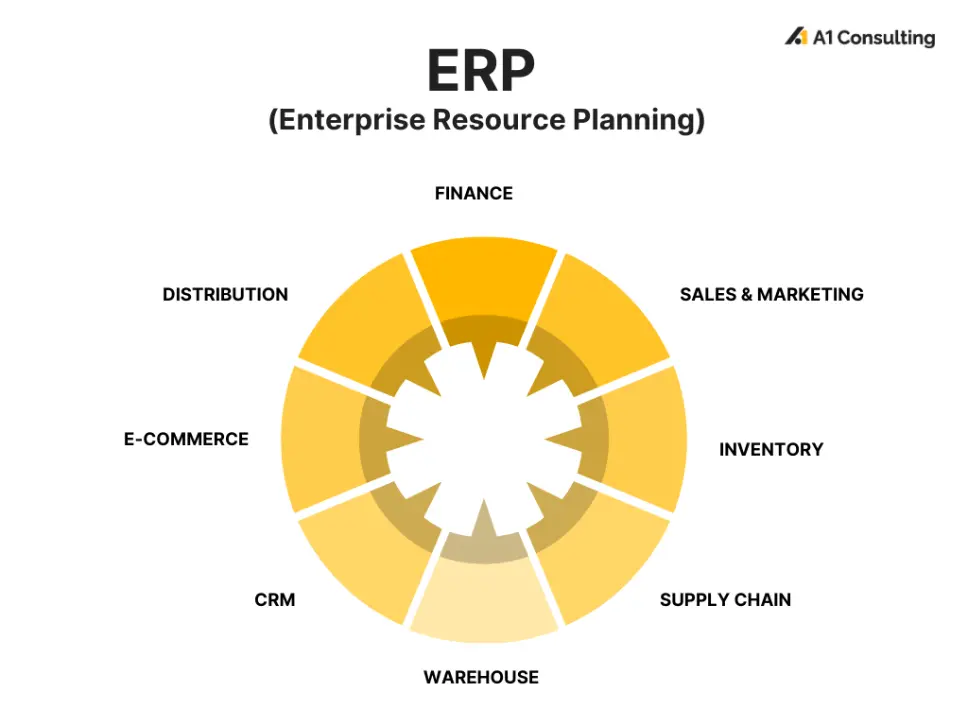
The adoption of an ERP system delivers numerous benefits to businesses, from streamlining operations to reducing costs and enhancing competitive advantage. By providing a unified, real-time view of organisational performance, ERP empowers smarter, data-driven decisions and more effective strategic planning. In a rapidly evolving market, ERP has become an essential foundation - helping companies stay agile, efficient, and well-equipped to succeed in a highly competitive landscape.
ERP Benefits
ERP improves the efficiency, productivity and profitability of businesses in various ways. Let’s explore some core advantages of applying ERP system into your business:
Business process automation
One of the key benefits of ERP systems is their ability to automatically handle repetitive tasks every day, such as order processing, inventory management, financial reporting, payroll and invoicing. This helps businesses to save a lot of time and money meanwhile helps to improve the accuracy and consistency of the operation process.
Data analytics and decision-making
By gathering and evaluating data across all departments of the organization, ERP systems deliver essential insights and forecasts related to finance, operational efficiency, overall performance, and more. This enables teams to plan more accurately and have better forecasting. Moreover, the ability to improve the decision-making of ERP is impressive by helping businesses maximize efficiency and make the right decision about allocating resources, managing inventory and serving customers with a single source of the firm’s data.
Better customer service
By providing the customer service team permission to access all customers’ information, ERP systems can help them resolve customer issues quickly and efficiently, then increase customer satisfaction and loyalty.
ERP Limitations
Despite many benefits, ERP systems also come with a few limitations such as their high cost, complex implementation, extensive and costly employee training and limited functionality for customer relationship management.
What is CRM?
Customer relationship management (CRM) nowadays has become a powerful and essential tool for all businesses that helps them to manage and nurture the relationships with clients, and leads effectively. Rather than focusing on internal processes, CRM software emphasizes to sales, customer service and marketing professionals.
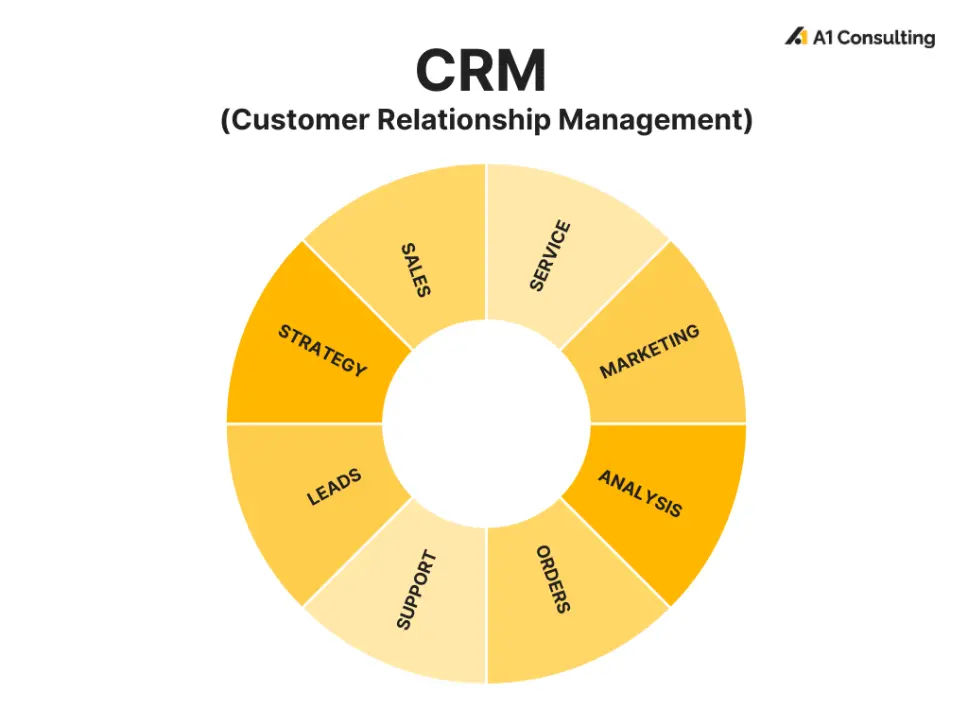
More specifically, CRM systems allow you to organize and track all essential customer data in a centralized database, including names, email addresses, contact methods, website behavior, preferences, purchase history, and every interaction you've had with them - from sales and marketing touchpoints to customer support requests.
CRM Benefits
As mentioned, CRM software significantly enhances the relationship between businesses and customers by gaining better insights about customers and optimizing sales activities that contribute to the overall success. Below are the key features of using CRM systems
Improve customer service and retention
CRM systems provide businesses a centralized platform where the support team can easily access to detailed customer information and past interactions, communication records, this helps to efficiently resolve customers’ concerns more efficiently in a shorter time, ultimately improving customer satisfaction and loyalty.
Additionally, CRM tools offer valuable insights of customer needs and behaviors. This deeper understanding allows businesses to customize their products, services, and marketing efforts to better match customer expectations - driving stronger retention and encouraging repeat purchases.
Automated sales and marketing processes
CRM systems have the ability to automate various sales and marketing tasks, such as lead generation, contact management, email campaigns, and sales forecasting. This streamlines workflows, reduces manual labour, and allows sales and marketing teams to focus on more strategic ideas in order to drive business revenue growth.
Valuable sales insights
Sales and customer service teams can take advantage of the analytical tools of CRM system to get insights improving processes and making data-driven decisions for better strategy development.
Increased efficiency and productivity
A core feature of CRMs is their automation capabilities that can automatically enter data, send messages, and handle repetitive tasks. This frees up time for team members to focus on the work that actually matters, improving efficiency and productivity.
CRM Limitations
The main limitation of CRM software is its narrow focus on front-office, customer-business relationship process, lacking robust operational and financial management tools because it is not designed to handle core business operations.
Additionally, CRM system cannot manage the transactional data including invoices, purchase orders or real-time inventory levels.
ERP vs CRM Comparison
ERP and CRM share several similarities in focusing on data management, the ability to track customer interactions and sales and finally, the ability to be integrated with other business applications.
CRM and ERP solutions are currently crucial for business operations processes in the digital transformation wave. Each system serves a distinct function and supports different areas of business operations.
ERP | CRM | |
Key features |
|
|
Target | Organization looking to manage and optimize core operational business across various departments | Organization looking to improve their customer relationships and sales performance |
Scope | All aspects of business, including front-office and back-office functions and operations | Only focus on the business’s sales and marketing functions |
Pricing | High | Medium |
Ultimately, both CRM and ERP are designed to enhance overall business performance. By understanding the similarities as well as differences between ERP, CRM, businesses can make informed decisions about which system is best suited for their organization based on their needs.
ERP vs CRM Adoption Forecast in Malaysian Market
According to Data Bridge Market Research report, the Malaysia ERP deployment market is expected to reach more than 750 USD Million by 2032 and is experiencing significant growth at a CAGR of 11.03% from 2025 to 2032. According to Statista report, The CRM software market in Malaysia is projected to grow at an annual rate of 11.44% to 633 USD Million by 2030.

Malaysia has a strong economic performance with a deversified economy, especially well-developed manufacturing sector, this is the key factor driving the ERP growth in Malaysia ERP market and a strong demand for ERP systems to streamline and optimize business operations efficiently. Furthermore, the rapid adoption of digital technologies acros industries increases ERP and CRM software's demand that help businesses to maintain competitiveness in a fast-evolving market.
As a result, Malaysian customers are increasingly looking for ERP solutions that are customizable, scalable, and easy to integrate with other business systems. They are also looking for software that can help them automate their business processes and improve their overall efficiency.
Why Do Businesses Need ERP, CRM or Both?
Over time, growing organizations usually end up needing both an ERP and a CRM. Which system they implement first depends on how their business operates, it depends on the company size, the nature of the industry and the specific business goals.
If the appropriate starting point is unclear, it is essential to first analyze your organization’s unique needs. The following considerations can guide you in determining whether a CRM, an ERP solution, or a combination of both is required.
You might choose the ERP solution for some reasons below:
- Operational insights: Comprehensive reporting offers businesses the insights needed to identify opportunities and avoid potential risks.
- Improved efficiency: By automating repetitive tasks across departments, ERP boosts productivity and streamlines day-to-day operations.
- Stronger supply chain management: ERP helps streamline supply chain management that businesses can quickly forecast demand and optimize production and inventory management.
Or you might choose to apply CRM system to obtain:
- Sales insights: CRM system can efficiently manage a database of all customer interactions and provide detailed insights and forecasts through insightful reports that significantly improve the sales process and customer support.
- Increased customer retention: Sales professionals can strengthen relationships and engage new leads, ultimately driving repeat purchases, higher loyalty, and better overall satisfaction.
- Marketing efficiency: Decreasing repetitive marketing tasks helps employees focus on other strategic and more important campaigns.
Ultimately, whether your organization implements CRM, ERP or both, the first step is always to evaluate the business needs, requirements and goals. In addition, it is a good idea to consult with a business software expert for detailed information as well as a comprehensive guide to implement the best system solutions for your business.
Want to Implement ERP, CRM Solution in Your Company?
Businesses are looking to enhance operational business processes and customer service can benefit from integrating Odoo ERP solution. Oddo ERP - the premier choice for small and medium enterprises (SMEs) by offering an open-source ERP software consolidates various business applications including eCommerce, CRM, accounting, manufacturing and project management within a modular platform.
With over 16+ years of expertise in ERP implementation and process optimization, A1 Consulting - an official Odoo Gold Partner provides strategic consulting, customized ERP implementations and full-cycle support for your business. A1 Consulting will help your business setup Odoo ERP deployment effortlessly and tailor the software to accommodate the company’s size and needs.
No more manual day-to-day task, no more handling technical details, we will manage every aspects for you! Here are some outstanding benefits when working with A1 Consulting:
- Time-saving and cost-efficiency
- Fair and transparent pricing model
- No vendor Lock-in
- Dedicated support from experts
- Level up your business performance
Final Words
Overall, CRM or ERP systems are sharing the similarities as well as the differencies. While CRM allows you to access and manage your sales and marketing activities, ERP is a software helps you to manage multiple business process in a comprehensive suite.
Exploring the Odoo ERP solution with A1 Consulting? Request a demo and A1 Consulting is here to discuss! We can guarantee a completely stress-free ERP deployment process for your business.
For more information, check out our comprehensive ERP implementation guide.

Sally N.
BDM - Partner and Alliance
With over 7 years of experience in ERP advisory, Sally has worked closely with SMEs across Malaysia to streamline operations and drive digital transformation. Her deep understanding of business processes and hands-on approach have made her a trusted advisor to many growing companies. Through this blog post, Sally aims to share practical insights and real-world lessons drawn from her implementation experience, offering guidance to businesses navigating their own ERP journey.