
ERP systems have become the backbone of modern business operations, integrating various departments and processes into a unified platform. Yet, one question frequently emerges among business leaders, IT professionals, and stakeholders considering ERP implementation: how many levels does a typical ERP system include?
Understanding the multi-level structure of ERP systems is crucial for several reasons. It helps organizations make informed decisions about implementation complexity, resource allocation, and long-term scalability. Whether you're a CFO evaluating ERP investment, an IT manager planning deployment, or a business analyst mapping process integration, comprehending ERP system levels directly impacts your project's success and ROI.
The concept of "levels" in ERP systems can refer to different aspects - technical architecture layers, functional tiers, or organizational deployment scales. This complexity often leads to confusion, making it essential to establish clear definitions and frameworks. A typical ERP system comprises multiple interconnected levels, generally ranging from three to six distinct layers, depending on whether you're examining technical architecture, functional capabilities, or organizational scope.
This comprehensive guide explores the various interpretations of ERP system levels, from the foundational infrastructure to user-facing interfaces. We'll examine classical architecture models, organizational tiers, and modern cloud-based structures. By the end of this article, you'll have a thorough understanding of ERP levels and how this knowledge translates into practical business value, enabling better planning, implementation, and optimization of your enterprise systems.
Defining ERP System Levels
Before diving into specific level breakdowns, it's essential to establish what "levels" actually mean in the context of ERP systems. The term can be interpreted in multiple ways, leading to potential confusion among stakeholders.
In technical terms, ERP levels typically refer to the architectural layers that comprise the system's infrastructure - from hardware and databases to application logic and user interfaces. These layers work together to process data, execute business logic, and present information to users. Think of them as a technology stack where each layer serves a specific function and communicates with adjacent layers.
From a functional perspective, levels can describe the hierarchy of modules and capabilities within an ERP system. This includes core transactional modules (like finance and inventory), analytical layers (reporting and business intelligence), and integration layers that connect with external systems.
A common misconception is confusing ERP levels with related but distinct concepts like tiers and modules. While these terms are interconnected, they represent different aspects of ERP classification. Understanding these distinctions prevents miscommunication during vendor selection, implementation planning, and system customization discussions. The layered architecture approach in ERP design promotes modularity, scalability, and maintainability - principles that enable systems to evolve with changing business requirements without complete overhauls.
What Are ERP Levels? Functional vs. Technical Layers
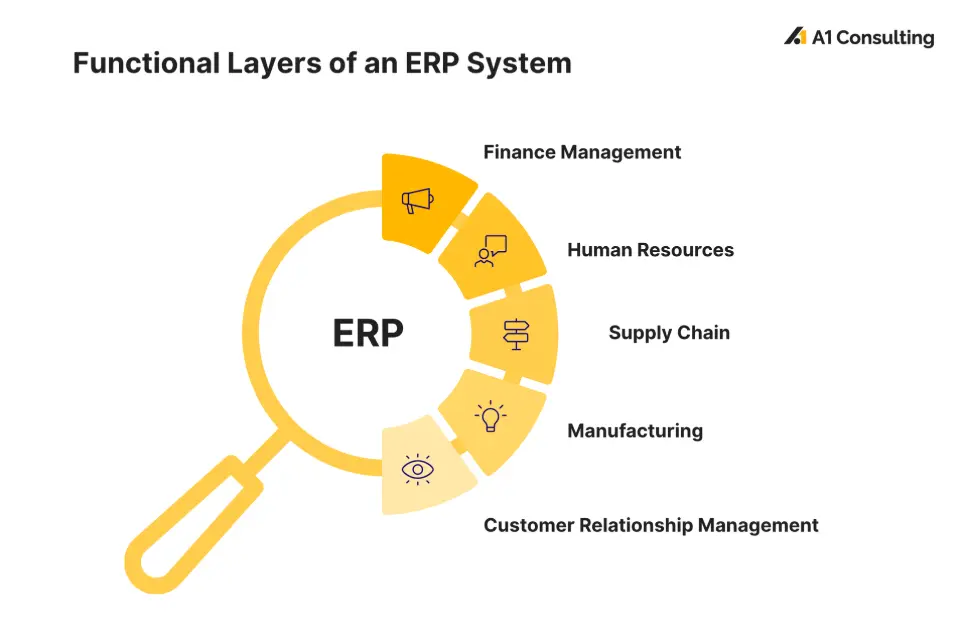
ERP levels manifest in two primary dimensions: functional and technical. Functional layers represent the business-oriented components - the modules and capabilities that users interact with to perform daily operations. These include finance management, human resources, supply chain, manufacturing, and customer relationship management. Each functional layer addresses specific business processes and workflows.
Technical layers, on the other hand, constitute the underlying infrastructure that enables functional capabilities. These include the database layer (where data is stored), middleware (connecting different components), application servers (processing business logic), and presentation layers (user interfaces). Technical layers are typically invisible to end-users but critical to system performance, security, and reliability.
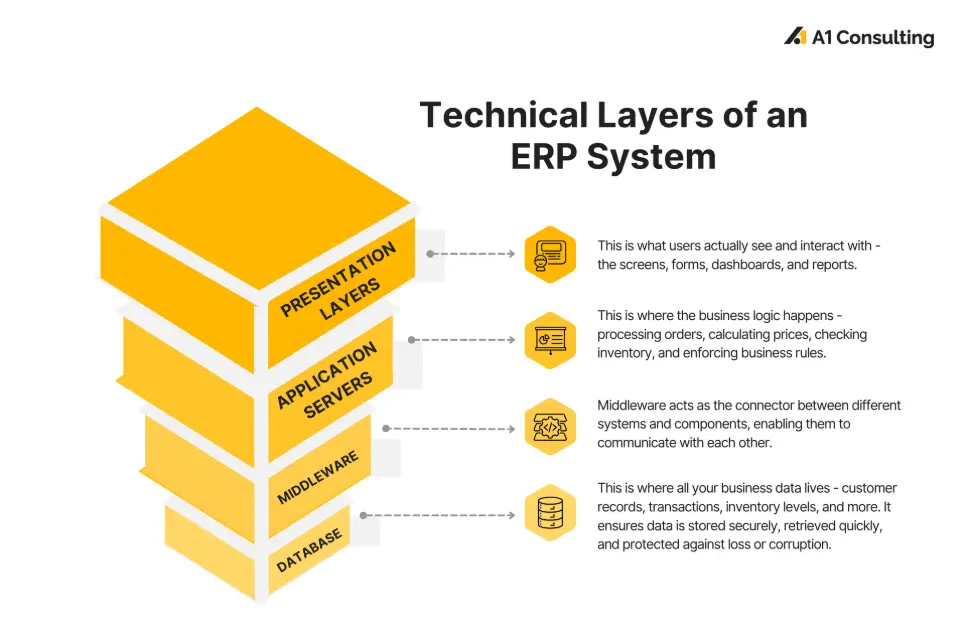
The distinction matters because implementation planning must address both dimensions. A company might select specific functional modules based on business needs while ensuring the technical infrastructure can support current operations and future growth. For instance, a manufacturing company might prioritize production planning and inventory modules (functional) while ensuring their database and server architecture (technical) can handle real-time data processing across multiple facilities.
Difference Between ERP Levels, Tiers, and Modules
Understanding the distinction between levels, tiers, and modules is fundamental to navigating ERP discussions effectively:
Concept | Definition | Purpose | Typical Usage |
Levels | Architectural layers or hierarchical components of the ERP system | Describe technical structure or functional hierarchy | "Our ERP has five levels: infrastructure, database, application, integration, and presentation" |
Tiers | Classification of ERP systems based on organizational size and complexity | Categorize ERP solutions by target market segment | "We need a Tier 1 ERP for our multinational operations" or "This Tier 3 solution suits our department needs" |
Modules | Functional components addressing specific business processes | Enable specific business capabilities within the ERP | "We're implementing finance, HR, and inventory modules first" |
Levels represent how components are stacked or organized within the system architecture. Tiers classify entire ERP solutions by their intended audience and scope - Tier 1 for large enterprises (SAP, Oracle), Tier 2 for mid-sized companies (Microsoft Dynamics, Infor), and Tier 3 for smaller organizations or specific departments. Modules are functional units that can be implemented independently or in combination, offering flexibility in deployment.
This distinction becomes critical during vendor evaluation. A Tier 2 ERP (classification by company size) might feature a four-level technical architecture (infrastructure, application, integration, presentation) and offer 15 different modules (functional components). Mixing these terms leads to confusion in requirements documents, vendor proposals, and project planning.
Core Levels of a Typical ERP System
A comprehensive ERP system typically comprises five to six core levels, each serving distinct functions while integrating seamlessly to deliver unified business management capabilities. Understanding these levels provides insight into how ERP systems process data, execute logic, and deliver value across the organization.
1. Infrastructure and Hardware Level
The foundation of any ERP system is its infrastructure and hardware layer. This level encompasses the physical or virtual servers, storage systems, networking equipment, and computing resources that host the entire ERP environment. In traditional on-premises deployments, this includes data centers, server racks, backup systems, and disaster recovery infrastructure.
Modern cloud-based ERP systems abstract much of this complexity, leveraging Infrastructure-as-a-Service (IaaS) providers like AWS, Microsoft Azure, or Google Cloud Platform. However, the infrastructure level remains critical - it determines system performance, reliability, scalability, and security. For example, SAP S/4HANA requires robust in-memory computing infrastructure to deliver real-time analytics, while NetSuite operates entirely on cloud infrastructure, eliminating on-premises hardware requirements.
This level directly impacts total cost of ownership (TCO), operational resilience, and disaster recovery capabilities. Organizations must decide between capital expenditure on owned infrastructure versus operational expenditure on cloud services, considering factors like data sovereignty, compliance requirements, and long-term scalability.
2. Platform and Middleware Level
Above the infrastructure sits the platform and middleware layer, which includes operating systems, database management systems (DBMS), application servers, and integration platforms. This level serves as the bridge between raw computing resources and business applications.
The database component stores all transactional and master data - customer records, product catalogs, financial transactions, inventory movements, and historical information. Leading ERP systems utilize various database technologies: Oracle Database, Microsoft SQL Server, PostgreSQL, or specialized in-memory databases like SAP HANA.
Middleware components facilitate communication between different system elements and external applications. Enterprise Service Bus (ESB) technologies, API gateways, and integration platforms enable ERP systems to exchange data with customer portals, supplier systems, e-commerce platforms, and third-party applications. For instance, Odoo employs PostgreSQL for data management and provides robust API capabilities for integration with external systems.
This level is crucial for ensuring data integrity, transaction processing, system performance, and interoperability. It handles critical functions like authentication, authorization, transaction management, and data synchronization across distributed components.
3. Core Application Modules Level
The core application modules represent the heart of ERP functionality - the business logic and processes that drive organizational operations. This level typically includes:
- Finance and Accounting: General ledger, accounts payable/receivable, asset management, financial reporting, and compliance. These modules ensure accurate financial record-keeping and enable informed financial decision-making.
- Human Resources Management: Employee information, payroll processing, benefits administration, time tracking, recruitment, and performance management. Modern HR modules increasingly integrate with talent management and employee engagement platforms.
- Supply Chain Management: Procurement, inventory management, warehouse operations, demand planning, and supplier relationship management. These modules optimize the flow of goods and information across the supply chain.
- Manufacturing and Production: Production planning, shop floor control, quality management, maintenance management, and product lifecycle management. Critical for manufacturing organizations to optimize production efficiency and quality.
- Sales and Customer Relationship Management (CRM): Order management, quote-to-cash processes, customer service, and sales analytics. These modules drive revenue generation and customer satisfaction.
- Project Management: Resource allocation, project accounting, time tracking, and milestone management for project-based organizations.
Each module contains configured workflows, business rules, validation logic, and reporting capabilities tailored to specific business processes. The modular design allows organizations to implement modules progressively, starting with critical functions and expanding based on maturity and requirements. For example, a company might begin with finance and inventory modules before adding manufacturing and CRM capabilities.
4. User Interface and Access Control Level
The presentation or user interface level is where employees, managers, and stakeholders interact with the ERP system. This level encompasses web portals, mobile applications, desktop clients, and specialized interfaces for different user roles.
Modern ERP systems emphasize user experience (UX) design, recognizing that adoption rates and productivity directly correlate with interface usability. Role-based dashboards present relevant information and functions based on user responsibilities - a CFO sees financial KPIs and analytics, while a warehouse manager views inventory levels and shipment schedules.
Access control and security mechanisms operate at this level, implementing authentication (verifying user identity), authorization (defining access rights), and audit trails (tracking user actions). Multi-factor authentication, single sign-on (SSO), and integration with identity management systems enhance security while simplifying user access.
Responsive design ensures consistent experiences across devices - desktop computers, tablets, and smartphones - enabling mobile workforce productivity. For instance, Odoo offers intuitive web-based interfaces with mobile applications for field sales teams, service technicians, and remote managers, ensuring accessibility regardless of location.
5. Reporting, Analytics, and Business Intelligence Level
Sitting atop the transactional modules is the reporting and analytics level, which transforms raw operational data into actionable business insights. This level includes standard reports, ad-hoc query tools, dashboards, data visualization, and advanced analytics capabilities.
Standard reports provide routine operational and compliance information - financial statements, inventory reports, sales performance, and regulatory filings. These are pre-configured based on common business requirements and industry best practices.
Business Intelligence (BI) tools enable deeper analysis through OLAP (Online Analytical Processing) cubes, data mining, trend analysis, and predictive modeling. Users can drill down into data, identify patterns, and explore scenarios to support strategic decision-making.
Modern ERP systems increasingly embed analytics within transactional interfaces, providing context-sensitive insights where decisions are made. For example, during purchase order creation, the system might display supplier performance metrics, price trend analysis, and inventory optimization recommendations.
Data warehousing and data lake technologies at this level consolidate information from multiple sources (ERP and external systems) to provide comprehensive analytical views. Integration with specialized BI platforms like Power BI, Tableau, or Qlik extends analytical capabilities beyond built-in ERP reporting.
6. AI and Machine Learning Integration Level (Optional but Emerging)
An increasingly common addition to ERP architecture is the AI and machine learning layer, which augments traditional ERP capabilities with intelligent automation, predictive analytics, and cognitive services. While not universally present in all ERP systems, this level is rapidly becoming standard in modern platforms.
AI-powered features include:
- Intelligent Process Automation: Robotic Process Automation (RPA) handling repetitive tasks like data entry, invoice processing, and reconciliation, reducing manual effort and errors.
- Predictive Analytics: Machine learning models forecasting demand, identifying maintenance needs, predicting customer churn, or detecting fraudulent transactions based on historical patterns.
- Natural Language Processing: Chatbots and virtual assistants helping users navigate the system, retrieve information, or complete routine tasks through conversational interfaces.
- Computer Vision: Automated quality inspection, document processing, and asset monitoring using image recognition technologies.
- Optimization Algorithms: Advanced algorithms optimizing production schedules, inventory levels, transportation routes, or resource allocation considering multiple variables and constraints.
Leading ERP vendors like SAP (with Leonardo), Oracle (with Oracle AI), and Microsoft Dynamics 365 (with Azure AI) embed AI capabilities across their platforms. Open-source solutions like Odoo increasingly incorporate AI modules for demand forecasting, customer segmentation, and intelligent automation, making advanced capabilities accessible to mid-market organizations.
Classical ERP Architecture Models Explained
To fully understand ERP system levels, it's valuable to examine classical architecture models that have shaped ERP design and continue to influence modern implementations.
The Three-Tier Architecture Model
The most traditional and widely recognized ERP architecture is the three-tier model, which separates systems into distinct layers with specific responsibilities:
- Presentation Tier (Client Layer): The user-facing interface where employees interact with the system. This includes web browsers, desktop applications, or mobile apps that present data and capture user input. The presentation tier focuses exclusively on display logic and user interaction, without containing business rules or data management logic.
- Application Tier (Business Logic Layer): The middle tier processes business logic, executes workflows, enforces business rules, and coordinates between the presentation and data tiers. Application servers host the ERP's core functionality - order processing, financial calculations, inventory movements, and process workflows. This centralized logic ensures consistency regardless of which client interface users employ.
- Data Tier (Database Layer): The backend layer stores all organizational data - master records, transactional history, configuration settings, and user information. Database management systems ensure data integrity, handle concurrent access, maintain backups, and optimize query performance.
This separation promotes scalability (each tier can be scaled independently), maintainability (changes to one tier minimally impact others), and security (sensitive data and logic are isolated from user-facing components). For example, you can upgrade the user interface without modifying business logic or database structures, or scale application servers to handle increased transaction volumes without changing the database infrastructure.
Service-Oriented Architecture (SOA)
As ERP systems evolved, Service-Oriented Architecture emerged as a more flexible approach, decomposing ERP functionality into discrete, reusable services. Rather than monolithic application tiers, SOA structures ERP systems as collections of loosely coupled services that communicate via standardized protocols (typically web services using SOAP or REST APIs).
Each service encapsulates specific business capabilities - customer service, order processing service, inventory service, payment service - and exposes well-defined interfaces. Other services or external applications can invoke these services without understanding their internal implementation.
SOA enables greater modularity, easier integration with third-party systems, and progressive modernization (replacing individual services without overhauling the entire system). Modern ERP platforms like SAP S/4HANA and Microsoft Dynamics 365 heavily leverage SOA principles, providing extensive APIs for customization and integration.
Comparison with Modern Cloud-Native Architectures
Contemporary cloud-based ERP systems often adopt microservices architectures, an evolution of SOA with even finer-grained service decomposition. Each microservice handles a specific business capability and can be developed, deployed, and scaled independently.
Cloud-native ERP architectures introduce additional levels:
- Containerization Layer: Technologies like Docker and Kubernetes package applications and dependencies, ensuring consistent deployment across environments and enabling rapid scaling.
- API Gateway Layer: Centralized access point managing API requests, implementing security policies, rate limiting, and routing to appropriate microservices.
- Event-Driven Integration: Asynchronous messaging systems (Kafka, RabbitMQ) enable real-time data synchronization and event-triggered workflows across distributed services.
These modern approaches increase agility, resilience (failures in one microservice don't crash the entire system), and continuous improvement (frequent updates to individual services without system-wide downtime). However, they introduce complexity in orchestration, monitoring, and data consistency management.
ERP Levels by Organizational Scope and Deployment
Beyond technical architecture, "ERP levels" frequently refers to organizational tiers - classifications of ERP systems based on their intended business scope, complexity, and target market. This perspective is crucial for selecting appropriate ERP solutions aligned with organizational size and requirements.
Tier 1 ERP: Enterprise-Level Systems for Global Organizations
Tier 1 ERP systems target large multinational corporations with complex operations spanning multiple countries, currencies, regulations, and business units. These comprehensive platforms include:
Examples: SAP S/4HANA, Oracle ERP Cloud, JD Edwards, PeopleSoft
Characteristics:
- Extensive functionality covering virtually all business processes
- Support for multiple subsidiaries, legal entities, and consolidation
- Advanced localization for numerous countries and regulatory environments
- Sophisticated supply chain and manufacturing capabilities
- Enterprise-scale performance handling millions of transactions daily
- Extensive customization and configuration options
- Typically high total cost of ownership (licensing, implementation, maintenance)
Tier 1 systems implement multiple levels internally - robust infrastructure requirements, complex middleware, comprehensive module suites, and advanced analytics. Implementation typically requires 12-24+ months and significant organizational change management.
Tier 2 ERP: Mid-Market Solutions for Regional Businesses
Tier 2 ERP systems serve mid-sized organizations - regional companies, growing enterprises, or divisions of larger corporations - requiring robust functionality without the complexity and cost of Tier 1 solutions.
Examples: Microsoft Dynamics 365, Infor CloudSuite, Epicor, IFS, Acumatica, Odoo Enterprise
Characteristics:
- Comprehensive core modules (finance, supply chain, manufacturing, CRM)
- Industry-specific functionality through vertical solutions
- Faster implementation timelines (3-12 months typically)
- Lower total cost of ownership compared to Tier 1
- Cloud-first or hybrid deployment options
- Balance between functionality and usability
- Growing ecosystems of third-party add-ons and integrations
Tier 2 solutions often implement four to five levels - simplified infrastructure (especially in cloud deployments), integrated middleware, core application modules, user interfaces, and reporting capabilities. They provide an optimal balance for organizations needing enterprise-grade functionality without Tier 1 complexity and costs.
Odoo represents an excellent example of a Tier 2 solution offering modular flexibility, allowing businesses to start with essential modules and progressively add capabilities as they grow.
Tier 3 ERP: Departmental and Small Business Solutions
Tier 3 ERP systems address specific departments, small businesses, or specialized requirements. These solutions prioritize quick deployment, affordability, and ease of use over comprehensive functionality.
Examples: QuickBooks Enterprise, Sage 100/300, Zoho Books, SAP Business One, Odoo Community Edition
Characteristics:
- Focused functionality for specific industries or departments
- Simplified implementations (weeks to a few months)
- Lower upfront costs and ongoing maintenance
- Intuitive interfaces requiring minimal training
- Limited customization and integration capabilities
- Typically on-premises or single-tenant cloud deployments
Tier 3 systems might implement three to four levels - basic infrastructure, streamlined application modules, user interfaces, and standard reporting. They suit organizations with straightforward requirements or serve as stepping stones before graduating to more comprehensive solutions.
=> Explore now: Top 5 ERP Systems for SMEs Malaysian Business
Deployment Models Impact on ERP Levels
How and where ERP systems are deployed significantly influences their level structure:
- On-Premises Deployment: Traditional model where organizations own and manage all infrastructure and software. Requires investment in all levels - hardware, platform software, application licenses, and ongoing maintenance. Provides maximum control but highest TCO and complexity.
- Cloud Deployment (SaaS): Vendor hosts and manages infrastructure and platform layers, delivering applications as a service. Organizations access via web browsers or mobile apps. Reduces infrastructure management burden and initial investment but may limit customization. Levels below the application tier become vendor responsibilities.
- Hybrid Deployment: Combines on-premises and cloud components. For example, core ERP might be cloud-based while specialized manufacturing systems remain on-premises, integrated via middleware. Requires managing multiple architectural levels across environments.
- Two-Tier ERP: Larger organizations increasingly adopt two-tier strategies - maintaining Tier 1 ERP at corporate headquarters for financial consolidation and governance while deploying lighter Tier 2 or Tier 3 solutions at subsidiaries, divisions, or acquired companies. This approach balances standardization with agility, reducing complexity and costs at operating units while maintaining enterprise-wide visibility.
Why Knowing ERP Levels Is Crucial for Businesses
Understanding ERP system levels delivers tangible business benefits throughout the ERP lifecycle - from initial selection through implementation, operation, and optimization.
- Strategic Planning and Scalability: Comprehending the multi-level architecture enables better capacity planning and scalability strategies. Organizations can anticipate infrastructure requirements, estimate implementation complexity, and plan progressive rollouts. For example, knowing that adding AI capabilities requires infrastructure upgrades helps budget and resource planning.
- Alignment with Business Processes: Understanding functional levels (modules and capabilities) ensures ERP selection aligns with business processes and strategic objectives. Companies can prioritize critical modules, identify gaps requiring customization, and plan phased implementations based on business priorities rather than vendor recommendations.
- Implementation Risk Reduction: Knowledge of technical levels highlights potential integration challenges, performance bottlenecks, and security vulnerabilities early in planning. This foresight enables proactive risk mitigation - selecting appropriate middleware, designing robust interfaces, and ensuring adequate infrastructure - reducing costly surprises during implementation.
- Enhanced Security and Compliance: Each ERP level introduces security considerations - infrastructure hardening, database encryption, application authentication, integration security, and user access controls. Understanding these levels enables comprehensive security architectures addressing vulnerabilities at each layer, essential for protecting sensitive business data and meeting regulatory requirements (GDPR, SOX, HIPAA).
- Optimized Integration Strategy: Modern businesses operate in ecosystems of interconnected systems. Understanding ERP levels, particularly middleware and integration capabilities, informs decisions about connecting e-commerce platforms, third-party logistics, customer portals, IoT devices, and specialized applications. This knowledge prevents integration architectures that create maintenance nightmares or performance bottlenecks.
- Total Cost of Ownership (TCO) Optimization: Different deployment models (cloud vs. on-premises) and tier selections dramatically impact TCO. Understanding which levels you must manage versus those outsourced to vendors enables informed build-vs-buy decisions. Cloud deployments reduce infrastructure and platform management costs but may increase long-term licensing expenses.
- Change Management and User Adoption: Recognizing that end-users primarily interact with the presentation layer while IT manages deeper levels helps tailor change management strategies. User training focuses on interfaces and workflows, while IT staff require deeper technical training on infrastructure, integration, and customization.
- Vendor Evaluation and Negotiation: Knowledge of ERP levels enables more sophisticated vendor discussions. You can evaluate technical architectures, question scalability claims, assess integration capabilities, and negotiate service level agreements (SLAs) covering specific architectural components rather than accepting generic vendor proposals.
ERP System Examples Demonstrating Levels
Examining how leading ERP vendors implement multi-level architectures illustrates these concepts in practice and highlights diverse approaches to ERP design.
SAP's flagship ERP exemplifies comprehensive multi-level architecture. At the infrastructure level, it can deploy on-premises (customer-managed hardware), private cloud, or public cloud (AWS, Azure, Google Cloud). The platform level utilizes SAP HANA, an in-memory database providing real-time data processing. Core application modules span finance, supply chain, manufacturing, asset management, and more, with industry-specific solutions. The Fiori user interface layer provides role-based, responsive interfaces. The analytics level includes embedded analytics and integration with SAP Analytics Cloud. Additionally, SAP Leonardo delivers AI/ML capabilities across modules. This exemplifies six distinct levels in a Tier 1 enterprise solution.
Microsoft's cloud-first ERP strategy integrates infrastructure with Azure cloud services, abstracting hardware management. The platform level leverages Azure SQL Database, Power Platform for customization, and extensive APIs. Core modules include Finance, Supply Chain Management, Commerce, Human Resources, and Customer Service (CRM integration). Modern web-based interfaces with Power Apps enable custom user experiences. Power BI delivers advanced analytics, while Azure AI services provide intelligent automation and insights. Dynamics 365 demonstrates tight integration across Microsoft's ecosystem, showing how modern cloud architectures simplify certain levels while enriching others.

Odoo represents accessible, modular ERP for mid-market organizations. Infrastructure is flexible - self-hosted on-premises, private cloud, or Odoo.sh (managed hosting). The platform utilizes PostgreSQL database and Python-based application framework. Odoo's strength lies in modular core application - over 30 main modules including Accounting, Inventory, Manufacturing, Sales, Purchase, HR, and Project Management, with thousands of community and commercial extensions. Web-based interfaces emphasize usability and speed. Built-in reporting with customizable dashboards covers analytics needs. While AI integration is emerging rather than comprehensive, Odoo's open architecture enables extension with external AI services. Odoo demonstrates how modular design allows progressive level addition, starting with essential infrastructure and core modules before adding advanced capabilities.

Acquired by Oracle, NetSuite pioneered cloud-based ERP for mid-market companies. Entirely cloud-based, it eliminates on-premises infrastructure requirements. Built on Oracle technology, the platform layer is fully managed by NetSuite. Core unified suite includes financials, CRM, e-commerce, inventory, and order management in a single database architecture (avoiding integration challenges of multi-system environments). Modern web interfaces with dashboard customization serve various user roles. Real-time analytics and reporting embedded throughout. NetSuite SuiteAnalytics provides advanced BI. AI features include demand planning and customer insights. NetSuite demonstrates benefits of unified cloud architecture - simpler management, faster deployment, automatic updates - ideal for growing businesses seeking enterprise capabilities without complexity.
These examples illustrate that while all comprehensive ERP systems implement multiple levels, the specifics vary based on deployment model, target market, and architectural philosophy. Understanding these variations enables more informed ERP selection matching organizational requirements, technical capabilities, and strategic objectives.
Unlock Your Business Potential with ERP Solutions
Ready to leverage a powerful, flexible ERP system that balances comprehensive functionality with accessibility? A1 Consulting specializes in Odoo ERP services helping businesses across industries transform their operations with this modular, cost-effective platform.
As an certifited Odoo Gold Partner, we understand the multi-level architecture of ERP systems and how to configure each component - from infrastructure and database optimization to module selection, user interface customization, and analytics integration - to match your unique business requirements.
Don't navigate the complexities of ERP selection and implementation alone. Contact A1 Consulting today to discover how Odoo can provide the multi-level ERP capabilities your business needs - with the flexibility and affordability that drives sustainable growth.

Sally N.
BDM - Partner and Alliance
With over 7 years of experience in ERP advisory, Sally has worked closely with SMEs across Malaysia to streamline operations and drive digital transformation. Her deep understanding of business processes and hands-on approach have made her a trusted advisor to many growing companies. Through this blog post, Sally aims to share practical insights and real-world lessons drawn from her implementation experience, offering guidance to businesses navigating their own ERP journey.